Advanced Medium Combat Aircraft prototype
Advanced Medium Combat Aircraft prototype expected by 2028-29
Model to involve private industry in the works; AMCA is India's fifth generation fighter jet and is expected to be ready for induction by 2034
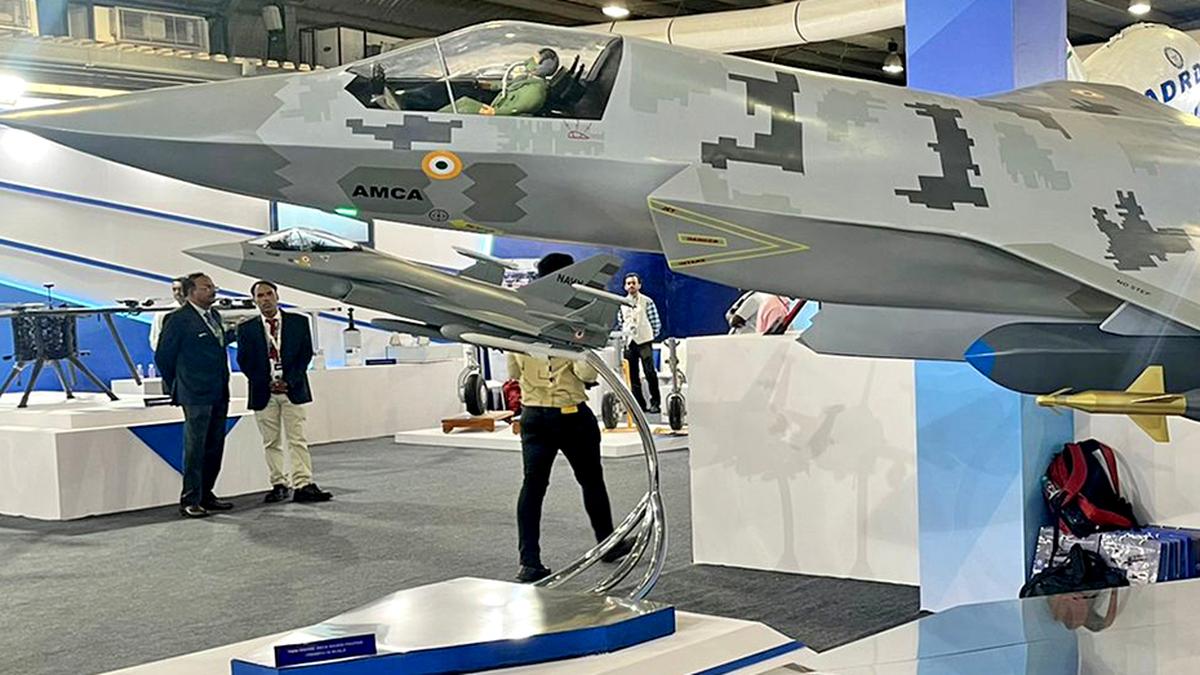
As the project for the design and development of the indigenous fifth generation fighter aircraft (FGFA), Advanced Medium Combat Aircraft (AMCA), makes progress, the Defence Ministry is working out a model for bringing in the private sector in a big way, which is important for timely execution of the project, according to official sources. The first prototype is expected to be ready by 2028-29.
"The design of the AMCA is ready. The prototype is expected to roll out by 2028-29 and the production is expected to begin from 2032-33. The target is to have it ready for induction in 2034, a decade from project sanction," an official source said. In preparation to have the manufacturing and deliveries on track, there is significant private industry involvement that is being envisaged. "We have to decide a model for private sector involvement. A model is expected to be worked out in the next six months," an official source said.
AMCA Programme
The AMCA programme, earlier known as the Medium Combat Aircraft (MCA) programme, is an Indian programme to develop a lifth-generation combat aircraft. It began as a parallel programme to the Indo-Russia Sukhoi/HAL FGFA The AMCA programme was launched in 2010. Although envisioned as a 20-tonne class fighter earlier, now AMCA is 25-tonne class fighter A feasibility study was launched in October 2010, followed by Project Definition and Preliminary Design phase in 2013 From November 2013 to December 2014, 9 design configurations of AMCA, starting from 3B-01 to 3B-09, were studied using CAD, low-speed-high-speed wind tunnel testing, and radar cross section (RCS) testing. By the end of 2014, configuration 3B-09 was chosen in 2015, the basic design configuration of AMCA was finalized, 211 and has been accepted by IAF in 2016. The design work was completed in 2023, and approval for the ₹15,000 crore (US$1.8 billion) project for prototype development was received in March 2024 DRDO expects to roll out the first prototype in three years and the first flight in one to one and (a) half years after that" (172 Total 5 prototypes are to be built. The first flight is expected in late 2028. The first three prototypes will carry out developmental flight trials, whereas the next two will focus on weapon trais. The prototype will be rolled out at an interval of 8-9 months 1753 Mass production of the aircraft is planned to start by 2035 projected) 2 The IAF plan to procure at least 125 AMCA in Mark-1 and Mark-2 configurations. The Mark 2 of AMCA is expected to have a more powerful engine,sixth-generation features and technologies to stay relevant in the coming decades.
Sixth generation technologies
In an interview given in 2020, the then Air Force Chief R. K. S. Bhadauria stated that "The planning process is already underway for combat systems like optionally manned sixth generation technologies, smart wingman concept, swarm drones. long persistent HALE (High-Altitude Long Endurance) platforms and hypersonic weapons, among others. He also added that it is imperative to incorporate such advanced technologies to keep AMCA relevant. It is also reaffirmed by IAF's currentchief Vivek Ram Chaudhan.
Sensors and Avionics
The AMCA is expected to have distributed passive sensors with Artificial intelligence (Al) assisted multi-sensor data fusion to increase situational awareness and to work in tandem with the advanced electronic warfare (EW) suite onboard AMCA The AMCA has a distributed processing system employing fast processors and smart subsystems. The AMCA will also have an integrated vehicle health monitoring system which works on sensor fusion
AMCA will be equipped with a larger and powerful variant of the Uttam AESA Radar which will use gallium nitride (GaN) technology it will be mounted on a mechanically steerable mount An onboard condition monitoring system is also planned to be included in the AMCA The platform will be equipped with a quadruple digital fly-by-optics control system using fibre optic cables to reduce weight, increase the rate of data transfer and reduce electromagnetic interference.


.jpeg)


Comments
Post a Comment